
Daily Struggles in Venezuela
Buenos Aires — As U.S. Navy operations continue in the Caribbean and discussions of a potential American invasion circulate, many Venezuelans express that their primary concern is not international conflict but rather their daily survival. The population, worn down by years of turmoil and violence under President Nicolás Maduro’s socialist regime, is focused on navigating life amidst economic hardship.
Recently, President Trump intensified pressure on Maduro’s government, which is viewed as illegitimate by Washington and much of the Western world. He revealed that he has consulted military advisors regarding the escalating situation between Venezuela and the U.S.
The U.S. Navy has been actively targeting vessels off Venezuela’s coast, claiming they are involved in drug trafficking. Trump stated, “I sort of made up my mind,” regarding actions taken to curb drug flow into the United States.
In response to these developments, Maduro has engaged in aggressive anti-American rhetoric while seeking support from allies like Moscow. He has mobilized troops across Venezuela as a precaution against potential threats from the U.S.
Despite Maduro’s fiery speeches, many citizens report being too preoccupied with basic survival to engage with his calls for national unity against perceived foreign aggression. Milos Alcalay, a former ambassador to the U.N., noted that state media may portray a wartime atmosphere, but daily life continues without such urgency.
The ongoing economic crisis has led many Venezuelans to rely on U.S. dollars received through remittances for essential goods like food staples. Yorelis Acosta de Oliveira, a political scientist at Central University of Venezuela, emphasized that economic concerns overshadow any fears about external conflicts.
The roots of Venezuela’s current predicament can be traced back to extensive nationalizations and an over-reliance on oil revenues during Hugo Chávez’s presidency. Following Chávez’s death in 2013 and Maduro’s subsequent rise to power, the economy spiraled further out of control.
An estimated quarter of Venezuelans—around 8 million people—now live abroad due to deteriorating conditions at home. The United States alone hosts approximately 770,000 Venezuelan migrants as of 2023.
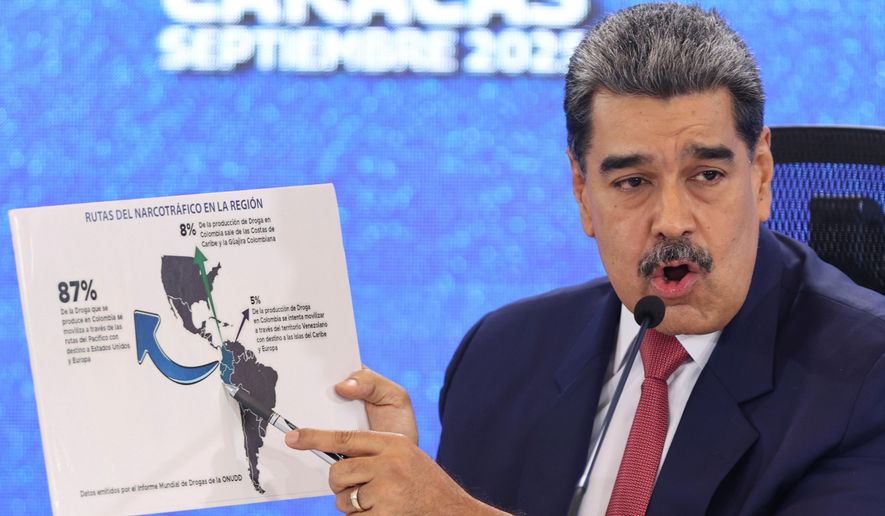
The Trump administration has labeled Venezuela a “narco-state,” accusing its leadership of facilitating drug trafficking operations that harm American citizens. Meanwhile, Maduro attempts to leverage anti-American sentiment among his supporters by highlighting issues faced by Venezuelan immigrants in the U.S.
The prospect of direct confrontation remains fraught with uncertainty; experts warn that any military action could exacerbate existing tensions rather than resolve them. Former National Assembly member Sergio Vergara remarked on the complexities surrounding regime change efforts and cautioned against violent solutions.
Human rights advocate Feliciano Reyna stressed that meaningful change will require time and cannot be achieved through abrupt measures against those currently in power. For now, millions remain focused on their immediate needs rather than distant geopolitical conflicts.


