
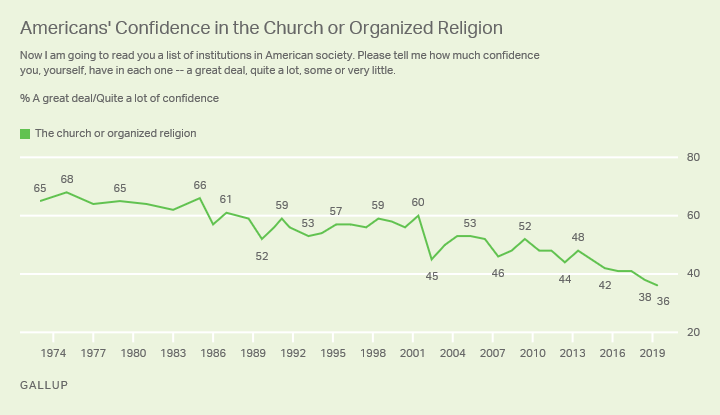
Significant Drop in Religious Importance
According to a recent Gallup poll, only 49% of Americans believe that religion plays a significant role in their daily lives, marking a decrease of 17 percentage points over the past decade.
This is the first instance where less than half of U.S. adults have reported this sentiment since Gallup began its annual surveys in 2007.
The findings indicate that Americans are now closer to the 36% of adults in 38 other affluent nations who consider religion important, narrowing a long-standing gap that has characterized the U.S. as particularly devout.
Benedict Vigers and Julie Ray from Gallup noted that such substantial declines in religiosity are uncommon, with only 14 out of 160 countries surveyed experiencing drops of at least 15 percentage points since 2007.
Countries like Greece, Italy, and Poland have seen even larger declines than the U.S., while Chile, Turkey, and Portugal experienced similar trends.
The results were derived from a randomized national telephone survey involving 1,000 adults aged 15 and older conducted between June 14 and July 16, with a margin of error of ±4.4 points at the 95% confidence level.
The analysts concluded that the United States is becoming increasingly unique: less religious compared to much of the world but still more observant than many economic counterparts.
The decline in religious adherence coincides with an increase in Americans identifying as having no religious affiliation, surpassing over 60 million adherents to the Catholic Church, which is the largest religious group in the nation.
The Rev. James Martin attributed some departures from faith to crises within institutions and noted that modern life demands often leave individuals with less time for spiritual practices.
Sociologist Christian Smith highlighted that each successive generation has shown decreased religiosity since the early ’90s, with Millennials exhibiting the most significant drop-off.
The Council on American-Islamic Relations pointed out that growing exclusionary attitudes toward religion in public discussions may contribute to this trend.
Morton Klein remarked on how religious observance declined during COVID-19 lockdowns when places of worship were closed. A Pew Research study indicated attendance at services dropped from 33% pre-pandemic to just 30% by 2023.
Klein also suggested that technology might lead people to prefer virtual interactions over traditional communal worship experiences.
A growing disillusionment with political scandals and misconduct has also driven individuals away from organized religion according to various commentators.
The Rev. Tom Reese emphasized that while young people express a desire for spirituality and community, many churches fail to meet these needs effectively.
Despite declining participation in organized religion, studies show many Americans continue reading scripture and praying independently.


