
Executive Order on AI Regulation
President Trump announced an executive order on Thursday that prohibits states from regulating artificial intelligence, establishing a framework for federal oversight of AI policy across the nation. This directive creates an AI Litigation Task Force led by Attorney General Pam Bondi, which will focus on challenging state-level AI regulations in court. The task force will argue that such laws unconstitutionally interfere with interstate commerce or conflict with existing federal regulations.
The order also mandates Commerce Secretary Howard Lutnick to inform states with contested AI laws that they risk losing access to the $42 billion Broadband Equity Access and Deployment program, which allocates federal technology funds to all U.S. states and territories.
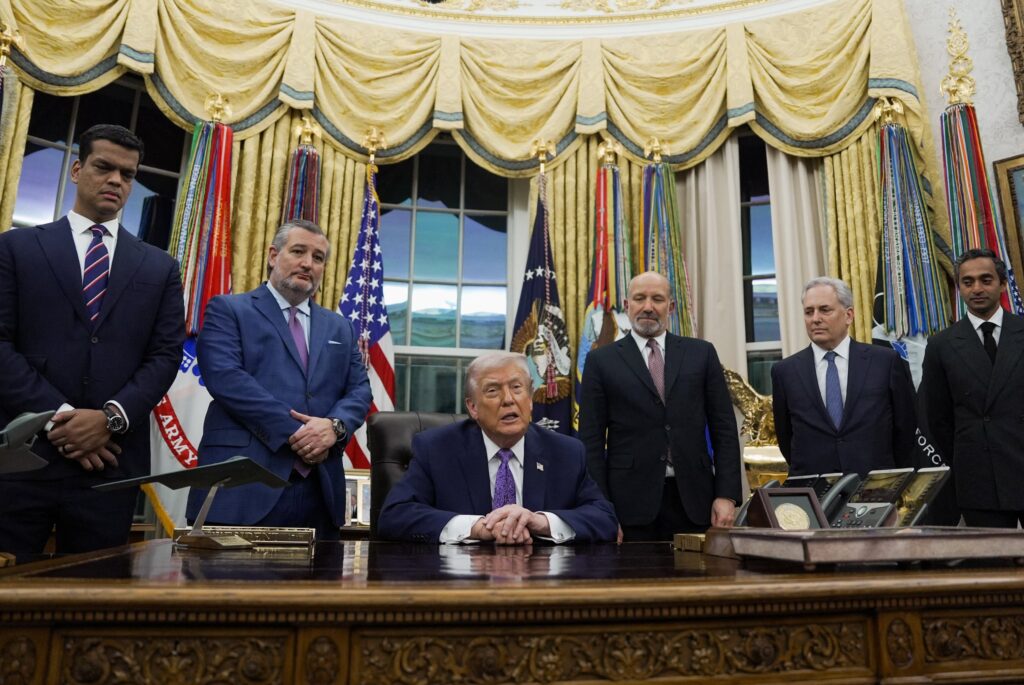
During the signing ceremony in the Oval Office, Trump emphasized the need for a centralized approval system to maintain American competitiveness against China. He argued that requiring approvals from 50 different states would be impractical and could jeopardize the entire industry if even one state adopts hostile regulations.
Trump pointed out that China has a centralized approval authority, which he cited as an example of regulatory efficiency.
David Saks, White House AI Czar, noted that there are over one thousand bills related to AI regulation currently being considered by state legislatures. He described this situation as a “confusing patchwork” of rules that creates economic uncertainty. Saks claimed that Trump’s order would eliminate burdensome regulations while still ensuring safety measures for children.
The initiative faced backlash from Democrats who labeled it as a favor to tech billionaires at the expense of essential safeguards for artificial intelligence. Alex Bores, a Democratic congressional candidate in New York’s 12th District, criticized Trump for failing to address potential dangers associated with AI technologies.
House Majority Leader Steve Scalise expressed his support for the executive order, calling it a significant move while Congress continues efforts to formally ban state regulations following a failed attempt to include such provisions in the annual defense bill. Scalise argued that California’s regulatory approach threatens American technological leadership and asserted that Trump’s actions could lead to billions in new investments.
Several states had previously enacted laws targeting issues like deepfakes and algorithmic discrimination in hiring practices. Critics warn that without proper oversight, unchecked development of AI could enable tech companies to evade accountability for consumer harm.
This past July, Congress blocked a Republican effort aimed at imposing a 10-year moratorium on state-level AI regulations when the Senate voted overwhelmingly against including this provision in Trump’s proposed legislation.
Even among Republicans, there were criticisms regarding this approach. Florida Governor Ron DeSantis referred to it as “federal government overreach,” arguing it benefits large tech companies while hindering states’ abilities to protect against censorship and other issues affecting consumers.


