
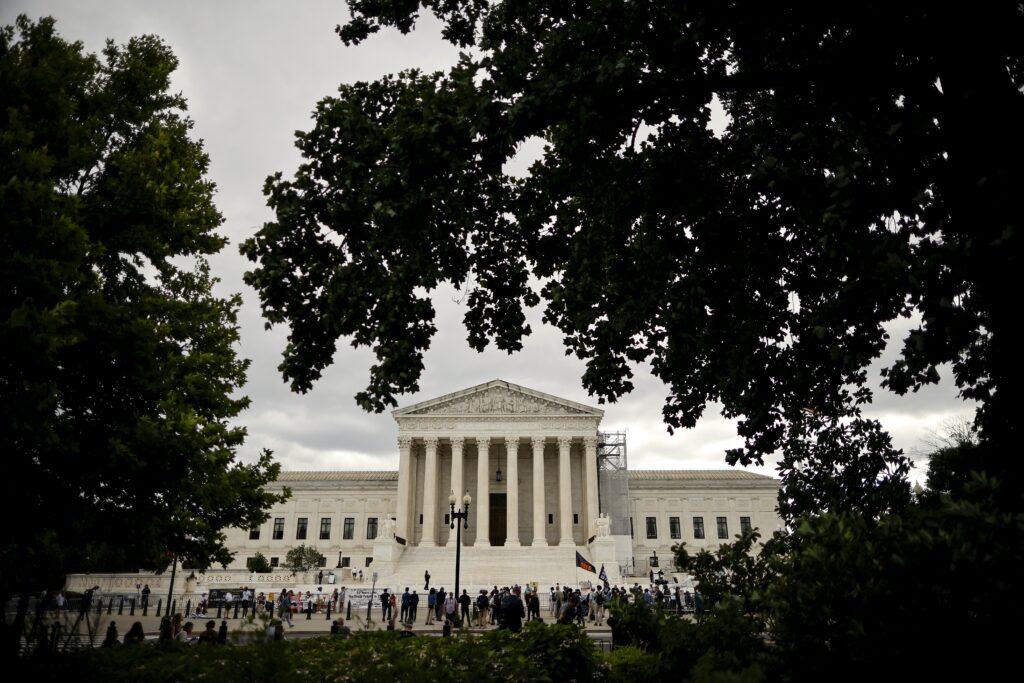
Supreme Court Decision on Passport Policy
The Supreme Court has granted President Trump the authority to proceed with a controversial policy that mandates U.S. passports to indicate a person’s biological sex, eliminating gender-neutral options. This ruling, announced on Thursday, asserts that the president is acting within his foreign policy powers.
This decision allows Mr. Trump to enforce the policy while ongoing legal disputes unfold in lower courts. The justices indicated that they would ultimately decide the matter if it reaches them fully.
The court stated, “Displaying passport holders’ sex at birth no more offends equal protection principles than displaying their country of birth — in both cases, the government is merely attesting to a historical fact without subjecting anyone to differential treatment.”
The ruling faced dissent from the court’s three Democratic appointees. Justice Ketanji Brown Jackson criticized her colleagues for hastily supporting Mr. Trump’s agenda, suggesting they should have waited for a more comprehensive case before making such a sweeping declaration. She described the ruling as a “painful perversion” of judicial responsibility.
Justice Jackson raised questions about the necessity of sex markers on passports altogether, noting that transgender individuals have valid reasons for wanting their documents to reflect their true identity.
“Airport checkpoints are stressful and invasive for travelers under typical circumstances — even without the added friction of being forced to present government-issued identification documents that do not reflect one’s identity,” she remarked.
The majority’s reasoning drew criticism from various quarters, particularly LGBTQ rights advocates who view transgender-friendly passports as symbolic of broader societal issues. Jon Davidson from the American Civil Liberties Union expressed concern over how this decision endangers transgender individuals by potentially exposing them to violence due to mismatched identification.
President Biden had previously established policies allowing Americans to select M or F or even X for gender markers on their passports. However, Mr. Trump rescinded this executive order, insisting that passports must “accurately reflect the holder’s sex,” which he argued is safer than relying on subjective interpretations of identity.
A U.S. District Judge Julia Kobick had earlier issued an injunction against Mr. Trump’s policy nationwide, deeming it discriminatory based on sex and referencing a 2020 Supreme Court ruling against employment discrimination targeting transgender individuals.
The First U.S. Circuit Court of Appeals supported Judge Kobick’s decision, reinforcing concerns about discrimination inherent in the passport policy.


