
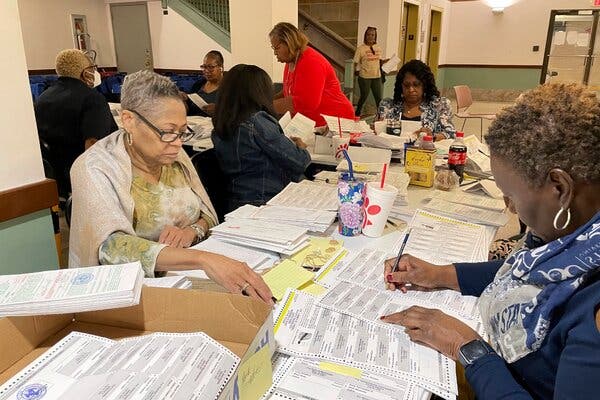
Supreme Court’s Upcoming Case on Mail-in Ballots
The Supreme Court announced on Monday that it will hear a case that may determine whether states are permitted to count mail-in ballots that arrive after Election Day, an issue that has become a point of contention between Democrats and Republicans.
The justices have agreed to examine a challenge against Mississippi’s policy, which was implemented during the pandemic. This policy allows mail-in ballots to be counted if they are cast on time and received within five days following the election.
The Republican National Committee has contested this law, leading to a lower appeals court ruling against the state. The 5th U.S. Circuit Court of Appeals stated that Congress established a single day for national elections, asserting that ballots must be both cast by voters and received by state officials.
In its appeal to the Supreme Court, Mississippi argued that if its law is deemed illegal, similar laws in many other states would also be invalidated. The state warned of potential election “chaos” unless the high court intervened.
“The stakes are high: ballots cast by — but received after — Election Day can swing close races and change the course of the country,” stated Mississippi Attorney General Lynn Fitch as she urged the court to take up the case.
The debate surrounding mail-in ballots has been ongoing for years but gained significant attention during the pandemic when states sought ways to facilitate voting while adhering to social distancing guidelines.
Many states abandoned previous requirements for voters to provide reasons for voting in person or by mail and extended deadlines for mailed ballots to be counted.
Initially opposed to early voting, President Trump has softened his stance over time but remains firmly against counting ballots submitted after Election Day. He likened allowing late arrivals to permitting individuals who show up days later at polling places post-election results, calling it absurd in a March executive order.
This executive order faced significant pushback from federal district courts. Earlier this year, the Supreme Court heard arguments regarding another case from Illinois where Republican Representative Michael Bost challenged his state’s law permitting mailed ballots received up to 14 days after Election Day.
Currently, nearly 30 states allow some form of ballot counting if they arrive post-Election Day, with most requiring them to be postmarked by that date. Some jurisdictions permit counting up until three weeks afterward, with these late votes often influencing election outcomes significantly.
An example can be seen in California where mail-in voting is prevalent; candidates have led on election night only to lose once all votes were counted due to late-arriving ballots.
Related Case: The case is Michael Watson v. Republican National Committee et al., with oral arguments anticipated later this term and a decision expected by June’s end.


