
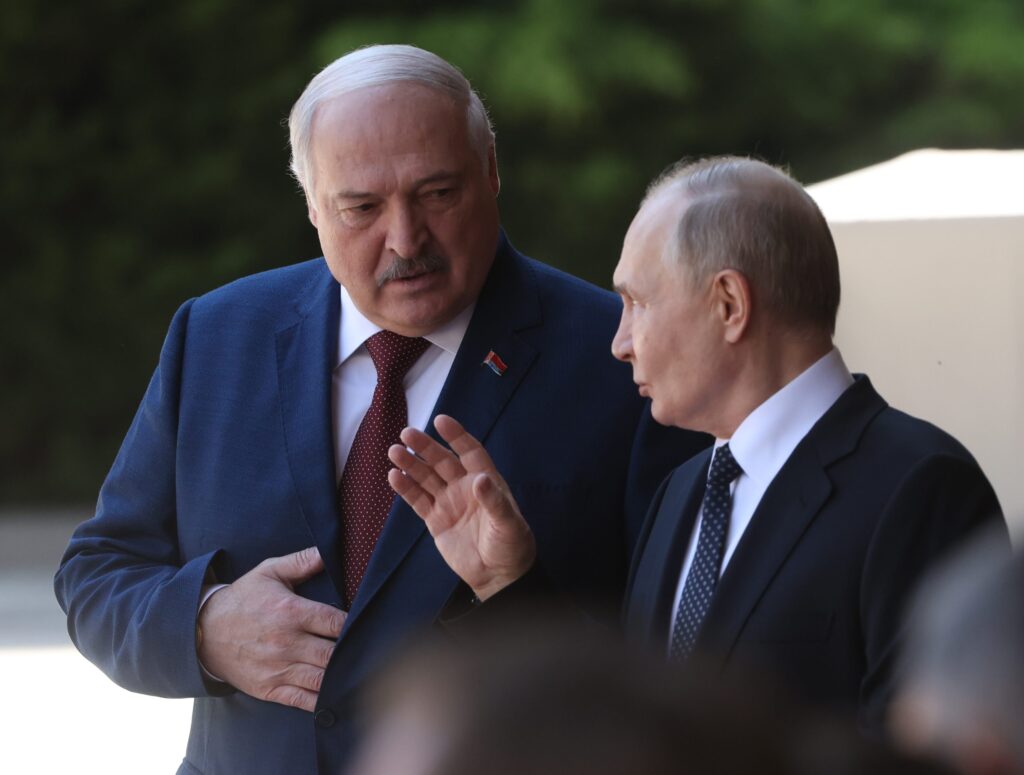
Belarusian President’s Outreach to the West
Belarusian President Alexander Lukashenko has expressed a desire to mend relations with Western nations in an effort to end years of international isolation and sanctions that have weakened his country’s economy.
In September, he released numerous political prisoners as part of a U.S.-brokered agreement that resulted in the lifting of certain sanctions on the national airline.
Despite these overtures, a recent study by the Atlantic Council indicates that Belarus remains largely under Russian influence. The report titled “Minsk in Moscow’s Grip: How Russia Subjugated Belarus Without Annexations” highlights how Lukashenko has aligned himself with Moscow since his presidency began in 1994, consolidating power by dismantling democratic institutions and suppressing dissent.
Analysts note that despite public opposition from many Belarusians who favor independence from Russia, Lukashenko’s government has effectively become a military outpost for the Kremlin. It is estimated that around 2,000 Russian troops are stationed in Belarus, which borders Europe’s largest country.
Lukashenko allowed Russian forces to launch attacks on Ukraine from Belarusian territory starting in February 2022. Although he did not deploy his own soldiers, he facilitated the invasion by granting access to airfields, railways, roads, and even oil refineries. Reports indicate that wounded Russian soldiers were treated in Belarusian hospitals.
Following the Soviet Union’s collapse in 1991, Belarus relinquished its nuclear arsenal and signed the Nuclear Non-Proliferation Treaty. However, a constitutional referendum held in February 2022 was criticized as being fraudulent and led to discussions about renouncing its nuclear-free status. Subsequently, Moscow deployed nuclear-capable Iskander missiles to Belarus.
The potential placement of Russian nuclear weapons in Belarus is seen as a strategy to unsettle neighboring countries. While these missiles would be under Russian control, their presence could make Belarus a target for future retaliatory actions.
The economic relationship between Belarus and Russia further illustrates this dependence; Belarus owes approximately $8 billion to Moscow and relies heavily on it for trade—over 70% of its exports go to Russia. The Kremlin also controls key infrastructure such as ports and railways within Belarus.
Minsk has become deeply integrated into Russia’s military supply chain, with more than 280 state enterprises supporting military operations by providing everything from advanced electronics to artillery shells.
Despite significant Russian control over its affairs, analysts suggest that Belarus is still attempting to garner favorable attention from other nations like China and the United States. Recently, former President Trump announced lawyer John Coale as Washington’s special envoy to Minsk due to his involvement in securing prisoner releases.
Lukashenko appears willing to release more prisoners as part of efforts to improve relations with the West. However, experts warn that without genuine reforms and an end to repression, this situation could devolve into a cycle where hostages are used as bargaining chips.


