
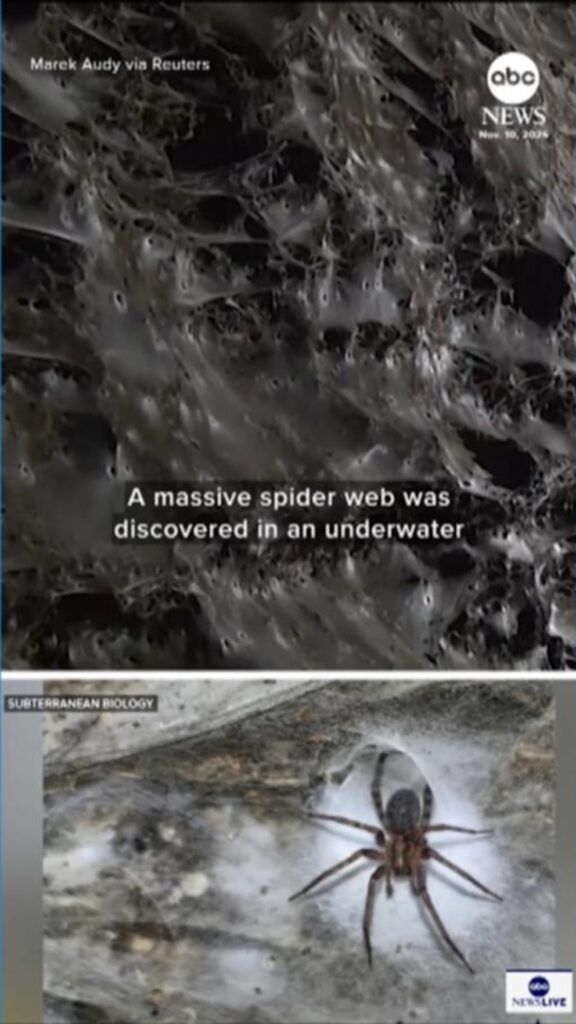
A remarkable discovery
A colossal multi-species spider web has been uncovered in a cave located on the border between Greece and Albania, believed to be the largest of its kind globally.
The sulfur-rich environment of Sulfur Cave supports various microbes, which in turn sustain both larval and adult midges. These midges provide nourishment for two distinct spider populations: approximately 69,000 barn funnel weaver spiders and around 42,000 sheet weaver spiders, as detailed in a recent study published in Subterranean Biology.
This extensive web spans roughly 1,140 square feet.
The shared web represents a groundbreaking instance of colonial web construction for both spider species involved, according to the researchers behind the study.
“I’ve been working with spiders for 18 years, and I’ve never encountered such a community,” remarked Blerina Vrenozi, one of the study’s authors. She noted that “neither of these species is social; they are typically solitary.”
The two spider populations are also genetically unique compared to other groups of their species found in different environments.
Marek Audy, a cave researcher who first identified the web in 2021, explained that “spiders in the cave lay about a third of the eggs compared to those living outdoors. They can afford to lay fewer eggs since it’s certain they will raise their offspring there.”


