
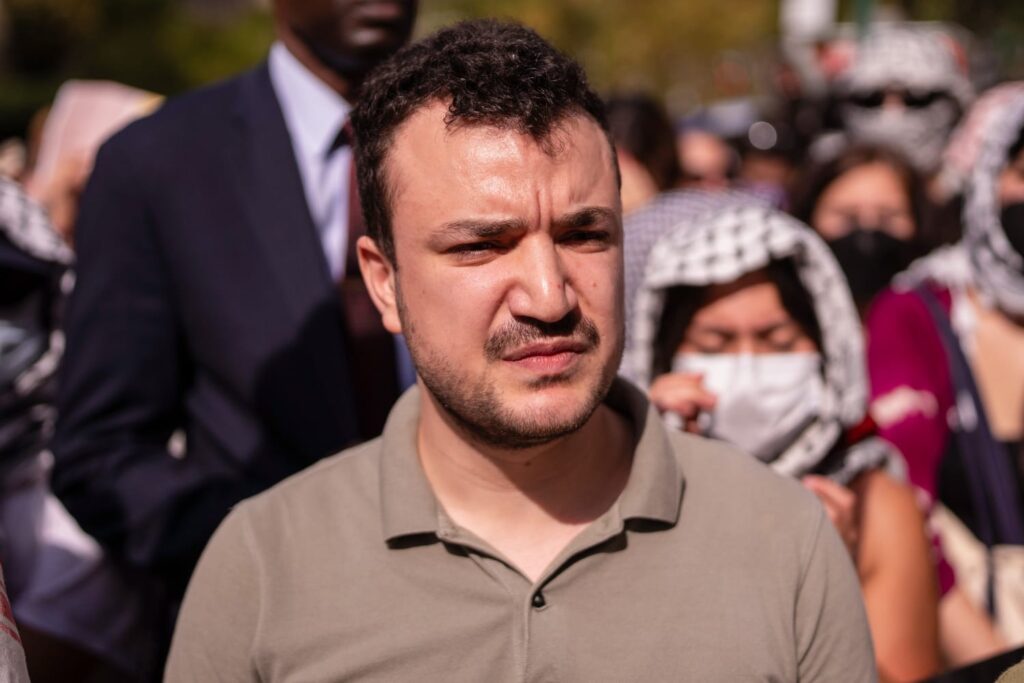
Court Decision on Mahmoud Khalil’s Case
The 3rd U.S. Circuit Court of Appeals ruled on Thursday that a federal district court exceeded its authority by issuing protective orders that prevented immigration authorities from arresting Mahmoud Khalil, a well-known pro-Palestinian activist. This 2-1 decision marks a significant win for the Trump administration in its attempts to deport Khalil, who has been in the spotlight for his participation in anti-Israel protests at Columbia University following Hamas’ attack on Israel in 2023.
The appeals court concluded that Khalil acted too soon by seeking intervention from a federal district court without first exhausting the immigration court system. The majority opinion stated that the Immigration and Nationality Act outlines specific procedural requirements for deportation cases. Therefore, Khalil must wait until his case is fully processed through the immigration courts, including any reviews by the Board of Immigration Appeals, before he can seek relief in federal courts.
This ruling reverses protections previously established by Judge Michael Farbiarz over six months ago and opens the door for Khalil’s potential rearrest and detention. The American Civil Liberties Union (ACLU), which represents Khalil, is contemplating an appeal. In response to the decision, Khalil expressed disappointment but reaffirmed his dedication to Palestinian causes and justice.
The ruling has wider implications for President Trump’s immigration enforcement strategies. Khalil had filed a habeas corpus petition challenging his detention in federal district court—a tactic increasingly used by migrants contesting heightened enforcement actions. The 3rd Circuit’s decision may significantly weaken this approach by mandating that challenges to immigration detention and deportation first go through immigration courts before being consolidated into a single petition for review at the circuit court level, effectively bypassing district courts where migrants have found success with habeas petitions.
The majority opinion was written by Judges Thomas Hardiman, appointed by George W. Bush, and Stephanos Bibas, appointed by Trump. Judge Arianna Freeman, nominated by President Biden, dissented from the ruling, arguing that current law allows Khalil to bring his case immediately.
Khalil was born in a Palestinian refugee camp in Syria and holds Algerian citizenship. He entered the United States on a student visa to study at Columbia University and married a U.S. citizen in 2023, subsequently obtaining lawful permanent residency. The Trump administration claims he committed fraud by hiding prior connections with a U.N. agency operating in Gaza. Secretary of State Marco Rubio has labeled individuals involved in pro-Palestinian demonstrations as threats to U.S. foreign policy interests, prompting Khalil to challenge both Rubio’s designation and his immigration arrest as unconstitutional retaliation.


