
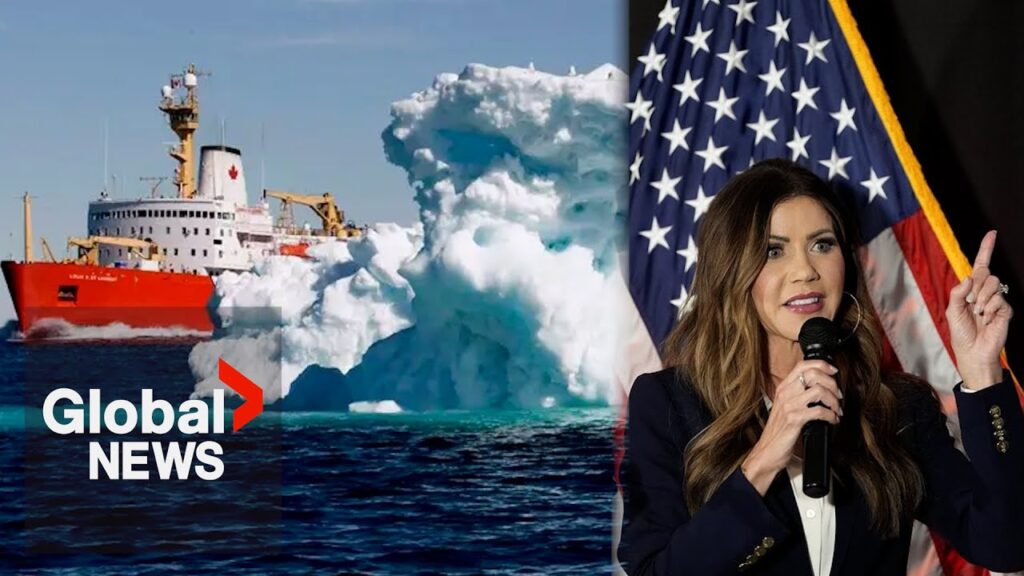
New Icebreaker Fleet Initiative
The U.S. Coast Guard is set to acquire 11 advanced polar icebreakers, primarily constructed in the United States, through a collaborative effort with Canada and Finland aimed at bolstering Arctic defense against potential threats from nations like China and Russia.
On Tuesday, Secretary of Homeland Security Kristi Noem, alongside Kirsten Hillman, Canada’s ambassador to the U.S., and Sakari Puisto, Finland’s Minister of Economic Affairs, formalized a joint statement of intent to enhance their icebreaker capabilities by fostering industrial cooperation.
During her address at the Department of Homeland Security headquarters in Washington, Ms. Noem emphasized that the Icebreaker Collaboration Effort—commonly referred to as the ICE Pact—is more than just a symbolic alliance among allies.
“It’s delivering tangible results for all our countries,” she stated. “It’s powering our economy and strengthening our Arctic defense. It’s bringing us one step closer to rebuilding our icebreaker fleet.”
The United States currently operates three polar icebreakers: the heavy-duty USCGC Polar Star, the medium-sized USCGC Healy, and USCGC Storis, which was acquired as a commercial vessel in December 2024.
As part of this agreement, both Finland and Canada have committed to investing in American shipyards while also training U.S. workers on specialized skills necessary for constructing polar icebreakers. In September 2025, Canadian shipbuilder Davie announced plans for a $1 billion acquisition of Gulf Copper & Manufacturing Corporation based in Port Arthur and Galveston, Texas.
Ms. Noem revealed that four of the new icebreakers will be built in Finland while seven will be constructed in the United States; construction on the first two has already begun.
“The expertise that Finland brings is incredibly valuable,” she noted. “They will continue construction while they train our workforce.”
Mr. Puisto highlighted that the ICE Pact has been developed “in the harshest of environments,” acknowledging that operating in the High North presents unique challenges due to its stunning yet demanding nature.
“Navigating ice is not merely a technical feat; it is ingrained in our culture,” he remarked. “It began as a necessity for survival and trade.”
The Coast Guard is poised to receive nearly $25 billion through the One Big Beautiful Bill Act—the largest funding commitment in its history. Senator Dan Sullivan from Alaska indicated that additional icebreakers will constitute a significant portion of this investment.
“When your cutters are 50 years old and your helicopters are 45 years old without adequate icebreakers for protection, you can’t do more with less,” he asserted.
Sullivan attended Tuesday’s signing ceremony and expressed his belief that new icebreakers should be stationed in Alaska due to heightened activity from Russian and Chinese forces.
“We’ve had six Russian incursions into Alaska’s airspace since August,” he stated. “We need these built quickly; there’s considerable action happening in my state.”


